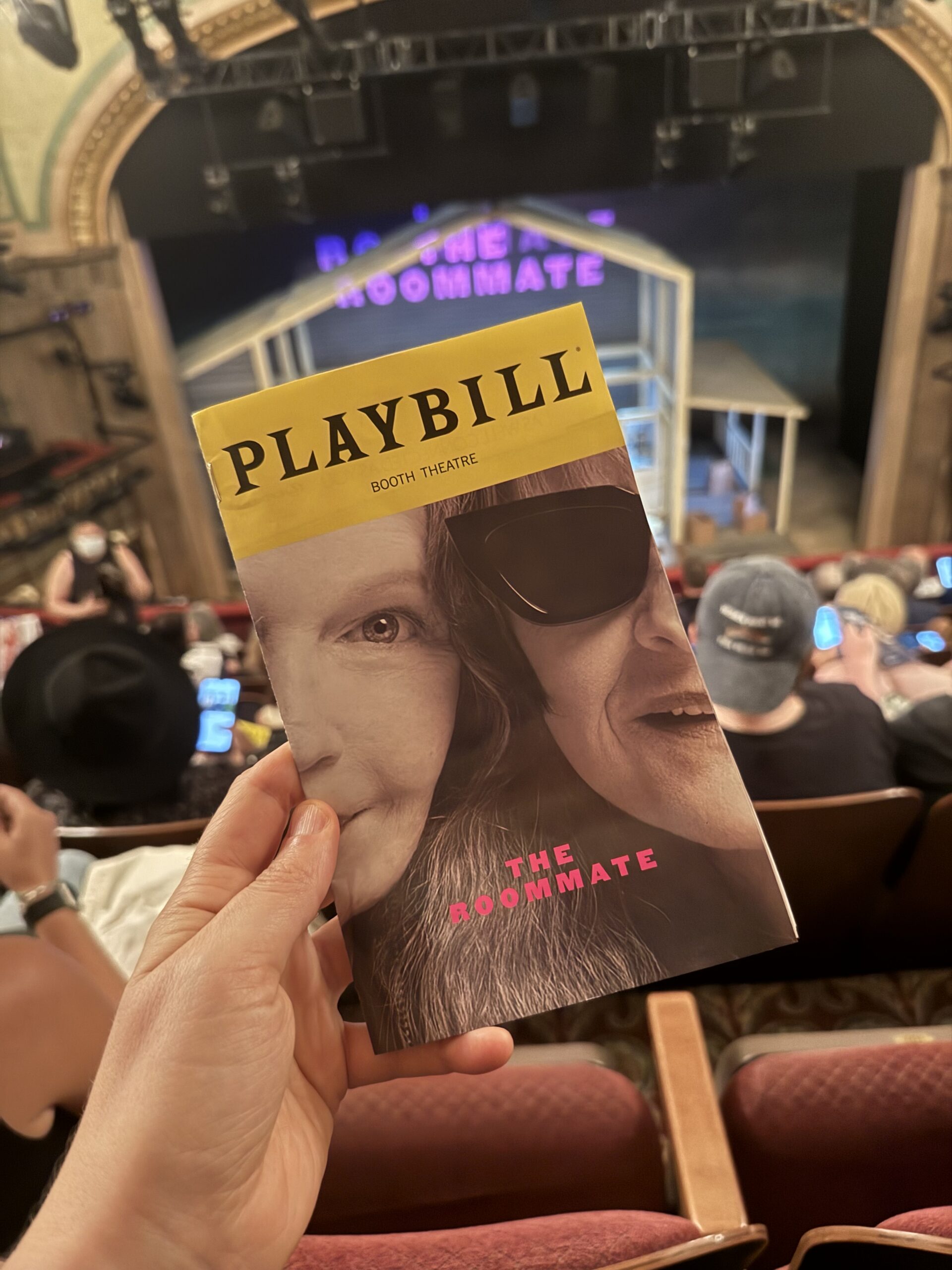
Saturday, September 14th, would have marked my third trip to see The Roommate on Broadway, a play that stars the deliciously fabulous Mia Farrow and Patti LuPone. At 6pm that evening, I got an email saying that the 7pm show was cancelled because Farrow tested positive for COVID. Hoping she gets better soon, not least because I can’t wait to see the play again, I decided to take a minute to write a review about the production and particularly the play, written by Jen Silverman, not least because of the number of reviews that seem to overlook the genius of both the text and the production.
[Spoilers to follow]
First, the text.
The Roommate, as published, tells the story of 54-year-old Sharon, who has lived alone in her spacious Idaho home since the departure of her husband, and 56-year-old Robyn, the titular roommate, fresh from the Bronx, looking for some peace and quiet as she turns over a new leaf (and quits smoking).
After a series of awkward getting-to-know-you situations, the two women form an unlikely but compelling bond. Sharon loosens up with the help of the free-spirited Robyn, and Robyn, perhaps a little less obviously, learns to avoid some of her past mistakes.
Those who have read the play or seen the production might take issue with that last supposition. After all, as soon as Sharon discovers evidence of Robyn’s salacious past (a collection of fake drivers’ licenses), she manages to convince Robyn to teach her to scam people (at least one person, anyway) and to sell cannabis products to her friends, a local book group.
Stunningly, one critic (male) suggested that the play sentimentalizes crime in the way that Broadway apparently did in the past. My mind immediately went to, well, Chicago, which I believe hasn’t changed its premise much, Moulin Rouge, and, perhaps, Cabaret, still running these days at The Kit Kat Club (The August Wilson Theater).
Another important detail for the story, and perhaps one that certain critics also find rattling, is that Robyn is gay and Sharon, admitting to having kissed a girl in high school, is at least curious about the possibility of what attraction to a woman might look like for her.
Okay, perhaps I’m reading into it a bit too much, but I don’t think so.
As a play, The Roommate offers a lot in the way of pointed comedy, attested by the consistent laughter from the audience. Objectively, jokes about Iowa, Idaho, and the Bronx are funny. People entertain stereotypes about the Midwest and about New York City. I had someone not that long ago question whether it was safe to come to my neighborhood in Hamilton Heights (it is) and whether it was safe to be on the subway (it is). As Robyn points out, though, “There’s parts. Parts you don’t wanna/ late at night you don’t wanna.” People also find different things scary. I, for example, find being out in the country way scarier than being in the city, but that’s me. Robyn is clearly perturbed by the idea of tornados, asking whether there are a lot of tornados in the region as soon as Sharon mentions them. Her anxiety is funny and relatable.
The play also pokes fun at the experience of being a woman of a certain age. Sharon and Robyn butt heads over what it even means to be in their 50s (or 60s), with Sharon feeling that she is at the end stages of her life, not having gone on a date since she met her husband and otherwise failing to have much of a social life beyond a local book group. It makes various jokes about motherhood. Robyn, who writes poetry, notes that she doesn’t “have a lot of patience for other people’s”; Sharon quips that she feels that way about children. As Sharon worries that her son and his partner don’t like her very much, Robyn retorts that children don’t need to like their parents, they only need to survive long enough to become them. Silverman even exploits the humor from Sharon’s intrusive parent behavior. When she worries that her Brooklyn-based son has not called or texted her on a Friday night, Robyn encourages her to give him space and manages to gently tease Sharon for being so apparently needy.
As Sharon comes out of her shell over the course of the play, the humor expands and shifts to incorporate the obvious tension surrounding the evolving central relationship. Lonely and bored, Sharon delights in the danger attached to smoking and selling pot, and “identifying” friends to scam. She insists to Robyn that she is just doing it for fun, even as she reads the Harvard Business Review for tips on growing the new enterprise. Robyn, becoming increasingly wary of the influence she has on her new friend, finds herself consistently surprised by Sharon’s unfolding enthusiasm and talents. Sharon’s own agency offers Robyn some new insights into the influence she had on her daughter, who (enthusiastically?) paid her way through college by running scams.
The play is not a celebration of crime, but an exploration of what it means to have lived according to very limited parameters. Sharon mentions that her mother not only called her “slow,” but that she told her not to do things. Having existed in what was presumably a fairly dull marriage for long enough to raise a child, Sharon is having fun for the first time. Robyn clearly recognizes the dangers, trying to rein her in, and ultimately doing so by removing herself from the equation. Like Sharon, albeit in very different ways, Robyn is trying to work out the constraints of her former life.
That the play manages to examine all of these elements and manifest an interesting connection between Sharon and Robyn that teeters, especially towards the end, on romantic, is a credit to Silverman.
Now to the production and the reviews.
The play opened at the Booth Theater on September 12th. I’ve never gone to an opening night, and I couldn’t go anyway this time because I had a Greek drama class in which I am the student (here’s to being a perpetual geek!). Nevertheless, I was eagerly awaiting the reviews for this production, not a little bit concerned that ticket prices might spike as soon as everyone realized how good it was. Having seen it twice, I was already veryaware and telling everyone they had to go ASAP.
Imagine my surprise when I opened my email and saw the first review from Deadline. The reviewer (male) praised the performers (tempted to say “obvious” here), but he took aim at the play. And he wasn’t the only one. In an article published by The Wrap, Robert Hofler not only called Love Letters a “so-so play” (see my previous review of Victor Garber and J. Smith-Cameron’s version of that), but adopted a sarcastic tone as he summarized The Roommate’s plot: he grumbled about the jokes about Idaho, Iowa, and the Bronx, critiqued Sharon’s lack of understanding about veganism (“[she] just can’t believe that somebody doesn’t eat eggs!”), and her awkward response to learning that her new roommate is gay (“[she] reacts to this news as if she’d just learned that other new meaning of the word”).
What I found most surprising, and inappropriate, is Hofler’s suggestion that the playwright, Jen Silverman, has “unfortunately confused Iowa with Afghanistan” and that she has likewise confused what Hofler calls the “‘now’ time frame’” of the play, whatever that means, with the 1970s. As someone who has actually taught for an Afghanistan-based university, I’m pretty sure that Silverman displays no such confusion. And as for the timeframe of the play, which some other critics take a shot at too, well, it’s never actually established exactly when the events of the play take place. Nor does a lack of specificity with regards to timeline make a play especially dated.
As I mentioned, I’ve seen the play several times (three and counting now), and I’m going to see it at least three more times. I also consider myself a bit of a theater snob. I am an English professor, and I love good theater, so to say that I’m surprised about the reviews is an understatement.
Perhaps I shouldn’t be surprised, though. Not because the play is bad (it’s actually really good), but because it does two things that apparently even Broadway is a tad bit uncomfortable with: it tells a story about older women, and it offers sapphic undertones as it does so.
Honestly, I think the sapphic undertones are the biggest issue here. I’m going to take my own shot at Hofler’s review, but he gives very little space to the implicit reason why Farrow’s character, Sharon, is so startled and ultimately intrigued to discover that her new roommate is a lesbian.
As mentioned above, the geographical setting is Iowa, somewhere near (although clearly not in) Iowa City. The time is less specific: Robyn, the roommate, has a cellphone, and the play itself was written circa 2015, but other than that, there’s nothing to really date the play. Sharon and Robyn are in their fifties in the play but aged to their sixties in the production. Honestly, you can place it anywhere between the 2010s and the 2020s, our current time and Hofler’s “now”, without difficulty. The one hold-up might be Sharon’s initial discomfort at the presence of cannabis plants in her home, but, as I’ll explain in a minute, I don’t think that necessarily requires that the play is set after the legalization of marijuana on any grand scale.
The play begins with Robyn, fresh from the Bronx, beginning to unload her various boxes and deposit them in her new room. Sharon, clearly unused to playing host and dealing with a fair amount of loneliness after the departure of her husband, is variously trying to help with the unloading and engage her new roommate in conversation. Having actually had roommates and been one myself, I don’t think there’s anything unrealistic about this presentation. In fact, both Sharon’s nerves and Robyn’s wariness make a whole lot of sense. Sharon betrays her own surprise that she’s having to get a roommate at her age, having presumably expected to, you know, remain married and therefore living with her husband. Robyn likewise seems appropriately perturbed to have to deal with a relatively nosy albeit well-meaning stranger, with whom she has a contractual relationship and nothing more. It’s not a stretch to imagine that she wants peace and quiet, but also knows that she needs to negotiate the initial interactions carefully.
Now, I want to pause here for a minute and say something about the experience of being a roommate as an older person – and by older, I mean, not between about 18 and 25. The most immediate experience I can think of, for myself, was back in 2015. I was 27, with two kids in tow, and I rented a room in a house in Cambridge, England, for about three weeks. My kids and I had just arrived in the UK, and I was beginning my undergraduate studies that October. We were set to live in university accommodation for the duration of my studies, but unfortunately, the flat we were renting was unavailable until late September, and school started at the beginning of the month.
My kids and I spent about two weeks in Wales, with my dad and his partner, wrapping up the end of the summer, before driving the five hours to Cambridge. My dad dropped us off with all our (too much) luggage, and we acclimated to being in the home of a complete stranger and their family – people we knew we were probably never going to see again. Not an entirely comfortable situation.
For the next three weeks, because we had to walk about a half-hour to the kids’ school, leaving at 7:30am to make it there for the 8am start, we woke up super early, well before our host family. We also had to negotiate dinnertime, tired after a long day at school but determined to make small talk as politeness required. Nighttime was tricky, too, because our host family had small kids and mine were nine and seven. We’re also perpetual night owls, but there we were, having to sit quietly in a tiny room, overflowing with our stuff.
My point in sharing this is that I don’t think all of the various critics reviewing The Roommate necessarily have ready points of reference for what it is to be a roommate past the traditional college years, and especially not when you’ve actually lived on your own for a good long while. Thinking about it now, I can’t imagine having a roommate: I feel it would be like holding my breath, walking on eggshells, no matter how much I might like the person. And Silverman’s play, for me, captures that experience, that complexity. She also quite deftly handles Sharon’s desperate desire for a friendship, for connections. She’s quick to try and befriend Robyn. She talks about her to her son, who lives in Park Slope, as if they are new friends. She tries to play host, too, suggesting things that Robyn can do to settle in and make friends.
Sharon’s reaction to hearing that Robyn is a lesbian, and indeed, her dubious awareness of her son’s sexuality – he has a lot of male friends and is dating a (former) lesbian – happens early in the play. Sharon talks about her son, the fact that he lives in New York, and his relationship comes up. Robyn volunteers that she’s a lesbian, and Sharon sticks her foot in it, responding with awkward surprise, although not, of course, anything that suggests she is anything but unused to the idea of homosexuality. She repeatedly explains that her awkwardness results from confusion and lack of exposure.
Perhaps I’m betraying some terrible ignorance here myself, but I think there’s a difference between being unused to the idea of someone being gay and the fact of being prejudiced against homosexuality in general. The unknown can be difficult to negotiate, and it often requires a learning curve. Having to acclimate to something is different from objecting to it, and people do have to acclimate to what they have never experienced before.
Time for another personal story, perhaps. My mother, who was married to my father for going on twenty-seven years, divorced him circa 2008 and is now married to my stepmom. Not one of her four kids had any problem at all with her new relationship. I think one of my brothers was upset about the way she handled ending things with my dad, but never did any of us fail to support her choice to be with my stepmom. Were we ever uncomfortable? Maybe. Probably. At first. I know my mom was uncomfortable, sharing her relationship, revealing that she had feelings for a woman after living an essentially heteronormative lifestyle for the bulk of her life. But that’s what I see with Silverman’s Sharon – someone learning to negotiate a new reality.
That new reality also extends to Robyn’s veganism and her use of medicinal marijuana. And again, I don’t know why such illustrious critics lack experience of this, but as someone who was both vegetarian for a time and who is at least nominally kosher among family members who are neither kosher nor Jewish, I’ll say again that I think Silverman is spot on in her representation of how a person new to something learns to acclimate. Sharon doesn’t immediately register that Robyn can’t eat eggs – yeah, my mom offered my Jewish kids ham and other pork products all the time without thinking.
As much as I think the play is actually great and deserves a lot stronger praise than it is received so far, I also want to acknowledge the obvious triumph of having Mia Farrow and Patti LuPone on stage. They are mesmerizing to watch. The chemistry between them is obvious, and it has been clear, in every production I’ve seen, that audiences are appreciating their depiction of these complex characters.
I also want to say a word about what happened on September 15th, the day after both the matinee and the evening performance were cancelled because Farrow was out.
Knowing that there would be a replacement for Farrow if the show happened, I deliberately bought tickets for the Sunday performance in what I hoped was a show of solidarity for the production. Expecting the understudy, the audience was informed that Marsha Mason was stepping in after only about four hours of rehearsal time that day. An associate director for the production, Mason clearly has a good handle on the play, but she (understandably) performed the sizeable part of Sharon with script in hand.
The beautiful thing, though, was how supportive everyone at the theater was. LuPone was clearly very generous in supporting Mason, helping her turn the page of the script on several occasions. Various people involved in the show stepped forward to help as well, and both actresses received flowers at the end of the show. The audience was also totally supportive of this rather unusual experience, literally cheering for Mason and LuPone partway through the performance.
I think it really takes a special production to create an experience like this. Farrow obviously brings her own unique take to the role, but Mason’s willingness to step in and just everything about the way the performance went that afternoon was beautiful to be a part of.
I really can’t wait to see the show again, whether it’s with Mason or Farrow. And I’m putting out into the universe now how much I would love to be able to get tickets for some of my students to see it too! It is nothing short of theater gold!